What is carry trading?

The carry trading is a strategy in which an investor sells a certain currency with a relatively low interest rate and buy another currency with a higher interest rate. The aim of this strategy is to get as profit the difference between the two interest rates, a benefit that may become attractive depending on the amount of leverage used. As the profit comes from the interest rate differential, you can make a profit even if the price of the currency does not change a single pip.

Although the Forex market operates 24 hours, is taken by consensus UTC 0 hours as the end and beginning of a new trading day. In Forex trading, at the end of each day is credited or charged to the account of the trader the spread between the interest rates of the two currencies of the currency pair in which the trader have open positions at this time (this is known as Rollover).

Read more

Little known utilities of Metatrader 4

MetaTrader 4, the most known and used platform for Forex trading has a lot of tools and options which are little known and used primarily by ignorance. This is due largely to the fact that very few users read the manual built into the platform. In this article we will see some of these options and utilities unfamiliar. (Much of what … Read more

Forex Market vs Stock Market

Investing in the Forex market offers huge advantages over buying and selling  shares in the stock market especially if you’re a small investor who does not have a large capital to invest. Here are the main advantages of the Forex market with respect to stock trading:

The Forex market operates 24 hours a day

The Forex markets operates continuously 24 hours a day, Monday through Friday. This market opens on Sunday at 14:00 hours (New York time) and closes on Friday at 16:00 hours (New York time). In this way,  traders from around the world have the advantage of being able to react quickly to the main news of the market and can set their own schedules to trade as they have the possibility to trade during the trading sessions in the financial markets in United States, Europe and Asia.

Read more

Pennant Chart Pattern

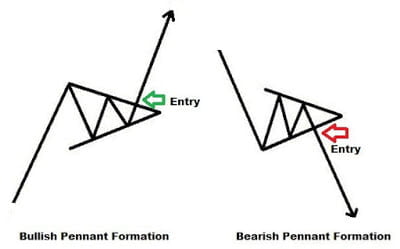
What are pennants patterns? The Pennant is one of the most popular patterns used by technical analysts and it is basically a short-medium term continuation chart pattern used by many traders in many financial markets. This chart pattern will exist and last long from one to three weeks of time. The pennants are formed in both bullish and bearish trends … Read more

Force Index Indicator


The Force Index is a trend-following oscillator that quantifies the movement of the market. It combines three basic elements such as the direction of movement, scale and market size. It relies on an auxiliary line to provide greater clarity so that it indicates a dominant bullish trend when the indicator remains above this line and a bearish trend when the indicator remains below.

Like all good indicators, the Force Index, has a very simple construction. This is simply to plot the slope between the last two prices and multiply the result by the volume involved. Once we have calculated the oscillator, the peaks are smoothed using an exponential moving average, because in its original form, these peaks can be very steep making it difficult to use in a trading system. The formula to calculate this indicator is the following:

Read more

Tips to identify the end of a Forex trend

Changes in the trend

A fundamental aspect that very few traders dominates how to determine when a trend is nearing its end and about to change to start a new trend. The turning point in which the change in the trend´s direction occurs is known as trend reversal. In many times the traders often find themselves in situations where they do not know if a trend will continue or reverse, for example when the market is in a lateral trend (the price moves without a defined trend).

In these cases these traders do not know if the trend is in a period of respite, gathering strength to continue  its movement or the market is at the beginning of a possible change in trend direction. In these and other similar situations the trader does not know whether to continue backing the current trend or wait a significant change in it. An error in this aspect can lead to large losses if the trader is not careful.

Read more

Producer Price Index Indicator

  General Definition The Producer Price Index-PPI indicator is a weighted index of average prices in the wholesale market, or in the manufacturing sector. This is a monthly figure, which always refers to the previous month in which the “Bureau of Labor Statistics” issued the report. This information is published between the second and third week.   The PPI shows trends in … Read more

Petrodollar

What is a petrodollar? A petrodollar is a dollar earned by a country with the sale of its oil to another country. The term Petrodollar was first used in 1973 by Ibrahim Oweis, professor of economics at Georgetown University. All OPEC (Organization of Petroleum Exporting Countries) sell crude in US dollars (USD), so that any country that wants to buy oil … Read more

Real Interest Rate Differentials Model

The Real Interest Rate Differentials Model indicates that movements in the price of currencies are determined by the levels of interest rates of the countries. Thus, the currencies of countries with high-interest rates should grow in value while the opposite should happen with nations whose interest rates are low.

As we will see below, this model is not able to explain all the movements in the currency market, although much of what happens in the Forex (and in other financial markets) is related directly and indirectly to interest rates.

Bases of the Model

Whenever a country raises its interest rates, international investors discover that the currency of that nation has a higher yield and therefore these investors start buying the currency. This theory was very successful in 2003 when the spreads of interest rates were quite close to the highest levels of the past years.

Read more

Interest Rate Parity Model

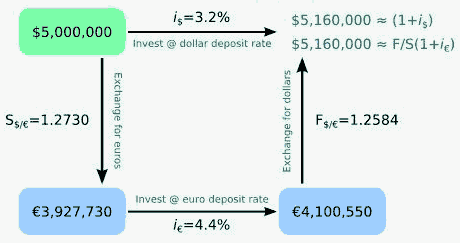
The Model of Interest Rate Parity states that in the event that two different currencies have different interest rates, then that difference will be reflected in the premium or discount to the price in the future, in order to avoid arbitration without risks.

For example, if interest rates in the U.S. are 3% and the interest rates of Japan are 1%, then the U.S. dollar (USD) should depreciate against the Japanese yen (JPY) by 2% to avoid what is known as risk arbitrage. This price or future exchange rate is expressed in the price at future date (forward) indicated on the current date.

Read more