Bar Charts in trading

Bar charts- A useful market analysis tool

The Bar charts are one of the various types of prices charts used to analize the market movements. The bar charts, unlike the line charts, shows the movement of prices for a specific period of time (can be 1 minute, 5 minutes, 1 hour, 1 day, 1 week, etc), besides the opening price, closing price, maximum price and minimum price. The bar is represented by a vertical line and two perpendicular horizontal lines. The high point in the bar is the maximum price achieved in the period while the low point is the minimum price in the same period. The two horizontal lines are arranged one to the right and the other to the left. The left side line represents the opening price and the right side line is the closing price.The information represented in the bar charts is more complex than that presented in line graphs, but is also more complete.

There are two types of bar charts used in Forex and other markets, and differ slightly from the information presented. One is called LHC (initials Low, High, Close) chart and the other OLHC (initials of Open, Low, High, Close) chart, and they look very similar in the graph but in fact there are some differences between them. These charts show bars with information on price movements of a currency pair in a given period. For example, if we choose to see a OLHC chart of the EUR /USD of 15 minutes, each bar shows information about what has happened in separated periods of 15 minutes in the Forex Market.

Read more

Technical Analysis in Trading

What is Forex technical analysis?

Introduction

There are two main approaches used to analyze and decide when to buy or sell in the market. These methodologies are called technical analysis and fundamental analysis and each one is based on radically different principles. In this section, we are going to discuss mainly about technical analysis but at the same time, we are going to present an introduction to fundamental analysis to explain this approach to visitors.

Fundamental analysis

In the Forex market, the fundamental analysis examines in depth the political, social, or economic events and how and why these events have historically affected the prices of currencies. So its main purpose is to understand the current state and likely evolution of the price action according to the socioeconomic circumstances that are currently being developed or in the process to be developed.

In the case of stock market analysis, for example, the fundamental analysis examines the financial reports published by the company, audits, quarterly and annual balance sheets, market trends, product quality, dividends, sales, position against competitors, news, etc… Ultimately this determines whether the stock price is below, above, or matches the price at which such share is quoted at the time. If, for example, the result of the fundamental analysis shows that the share price should be higher than what is listed at that time, the recommendation is to buy it and wait for the market’s true value.

In the case of the Forex market, fundamental analysis studies the economic, political, social, and even weather events that can affect the exchange rates of the currencies mainly in the long term.

Read more

Day Trading Myths Revealed

Day trading is a popular investment strategy used in Forex and other markets that involves buying and selling financial assets within a single trading day. While some investors have found success with day trading, it has also been the subject of many myths and misconceptions. In this article, we’ll take a closer look at some of the most common myths surrounding day trading and unveil the truth behind them.

In the following article there is a complete collection of Forex daytrading strategies: The best Forex daytrading strategies

Read more

Pivot Points in Trading

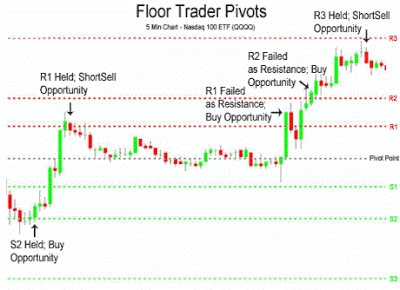
Pivot points are a popular technical analysis indicator used in trading to identify potential support and resistance levels for an asset’s price. These levels are calculated based on the asset’s high, low, and closing prices from the previous trading session. They are used to determine levels at which the price is likely to bounce or continue the current trend. In this article, we are going to show the different types of pivot points that exist, their calculation, and some suggestions for their use.
Pivot Points in trading
Standard Pivot Points

Traders use pivot points to help determine potential entry and exit points for trades. For example, if the price of an asset is approaching a pivot point level that is also a resistance level, traders may consider selling the asset as the price is likely to encounter selling pressure at that level. Conversely, if the price is approaching a pivot point level that is also a support level, traders may consider buying the asset as the price is likely to find support at that level.

Pivot points are most commonly used in intraday trading, but they can also be used for longer-term trades as well. There are several different methods for calculating pivot points, including the standard method, the Woodie’s method, and the Camarilla method, among others.

Read more

What is market sentiment & how to use it?

Traders are often searching for new indicators that help them to understand the market better and allow them to enhance their trading strategies. While the indicators that could be plotted over the chart remain the most popular, there are actually other tools that can benefit your trading strategy quite a lot. Today we are going to uncover one of such tools – market sentiment.

What is market sentiment?

The good news are that this indicator does not have any mathematical formulas behind it, hence understanding it is pretty easy. Also known as Bulls and Bears, market sentiment is a tool that is used to measure the psychology and the attitudes of the trading crowd.
Imagine EUR/USD is currently traded at 1.1500. As a matter of fact, there should be traders with long positions. However, there are also should be trading going short on this currency pair. The main question is, whether does the majority of the traders predict the market to go? And this is easily answered by the market sentiment. The indicator is usually shown as a pie chart that is split into two parts – traders that are short and traders that are long on a given instrument.

Read more

Stages that characterize a bullish or bearish market

The phases that characterize the bull and bear markets are as follows:

– Bull Market

This type of market is produced when the advance of prices reaches a level higher than the previous advance. Likewise, when no secondary trends become established below the latest peak. We can identify three phases in a bull market:
  • Accumulation phase: At this stage falls occur in the market as the investors sell because the economic news are mostly negative. There is a moderate activity that begins timidly to recover.
  • Recovery or expansion phase: In this case the activity begins with a modest progress and it produce a shy rising in market prices.
  • Distribution phase: There is great activity in the market. There are major upward movements in market prices and trading volume and investors take long positions without objection.

Read more

Four Myths About Forex Trading

The main myths related with Forex trading 1) “If you know how to trade in the stock market, you know how to make money in Forex” If you have experience trading with shares and you believe that you can simply apply that knowledge to make Forex Trading, then you will be very disappointed. The truth is that the Forex market … Read more

Why So Many Traders Fail?

The trader and the market

The reality is that the numbers do not lie, almost 90% of those who are starting for the first time in the financial markets like Forex just fail and lose their hard earned money. In fact, there are only a few traders who makes huge profits and live comfortably with this activity. The question that comes to mind then, is why many people fail when begin to trade in the market?
 
In my opinion it is not a matter of intelligence, since even highly intelligent and prepared people is swept by the market very easily. In fact it is not uncommon to see doctors, lawyers, economists, engineers and similar losing large amounts of money constantly, money that they can not afford to let go as if nothing. It is also possible to find people whose skills and academic preparation is not the best, but they have being successful  market speculators and therefore earns tons of money.

Read more

Forex Articles

In these section we are going to include general articles about Forex and the financial markets. These articles will have a variety of topics, from trading systems, system evaluation, trading psychology, market analysis, Forex brokers, Forex autotrading, Forex signals and more. In this way, the trader may complement their training with interesting articles that will give you a more complete picture of trading.

These articles will be written by traders with experience in the financial markets, mainly in Forex. If you have any questions or suggestions about an article that you would like to read, please let us know.

Likewise if you wish to contribute with some articles written by you, you will be welcome. If you want we can include the name of the author and the link you want.

Read more