Simple moving averages (SMA) – Definition and features

The simple moving average is basically the simplest way to calculate a moving average. This is an arithmetic mean in which the sum of the last N prices (P) will be taken and divided by N, where N is the period. In other words is an average where all data prices have the same weight. Remember that the most usual is to calculate this indicator using closing prices and therefore from now on we will refer to the closing prices.

It is one of the most used technical indicators by traders in all markets. Many trading systems use simple moving averages, mainly as a trend indicator.

The simple moving average is usually represented by the acronym SMA.

Read more

Double Bottom Pattern – Definition & Description

 
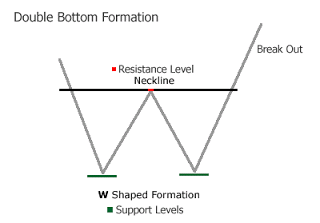
If you are a pro Forex trader, you would certainly know a lot of information on the double bottom chart pattern. In this case, Double Bottom is a high potential chart pattern which is significantly taught in Forex training. Moreover this is one of the best and successful patterns that are being followed by many successful Forex traders. This chart pattern looks very similar like the alphabet ‘W’. Expert Forex traders most usually expect the price to be in down trend making a BOTTOM. It will slightly rally up while it is sold down with the previous bottom. We can say that this figure is the opposite of the Double Top pattern.
Forex traders generally look around for a fair increase when the market hit the resistance. For giving you a better idea in this regards, here is an example for reference: Just consider when the market drops down from $10 to the least of $2 during the 1st bottom, here the $2 buyers explore the market and drive-up the price at least for $5, where the sellers disdain the $5 level and trade the market again to $2. At this point, the price of the 2nd bottom remaining with $2, the buyers find it easier to get at $2 and further escalate the market again to $5. During this point after minor conviction, they will be able to push the market to $5 again.
Generally, the double bottom pattern appears while the price falls down and further bounces up and then falls down for the 2nd time in order to equalize the 1st drop. This is why experts compare this chart with the alphabet W. In most of the cases, the 2nd bounce in the price will usually be lesser compared to the first one. The 2nd chance of buying will get its peak which will be lesser than the 1st one. If the 2nd peak reaches, buying gets its end and now selling starts. This entails the 2nd leg of M pattern.

Read more

Support and Resistance in Trading

Two of the most basic concepts in the technical analysis of the financial markets are both the resistances and the supports. And when we talk about basic concepts we mean that they are very simple to understand and at the same time they are one of the pillars on which the technical analysis is based. First of all, we are going to define what is support and what is resistance.

  • Resistance is defined as a level or price above the current price at which the selling force will stop and eventually exceed the buying force so that it puts an end to the bullish momentum. This causes the price to begin to fall and even to reverse the upward trend. In a price chart like the one shown in the following figure, the resistances can be identified as previous peaks reached by the price before falling. In an upward trend, the resistances can be visualized as increasing highs.
  • The concept of support, on the other hand, is opposite to that of resistance. Support is defined as a level or price below the current price in which the buying power equals and eventually exceeds the selling power so that the bearish momentum is stopped and this will cause the price to rise and even the bearish trend could be reversed. Generally, in a price chart, the supports can be identified as minimums reached before the price starts to rise. In a bearish trend, the supports can be identified as increasingly lower minimums.
The following image shows several real examples of resistance (lines R1, R2, R3, R4, and R5) and supports (lines S1, S2, S3, S4, and S5).

Read more

What is price action?

Price action is a common term used in trading to refer to the analysis of the movements made by the price of a particular asset or financial instrument in the market.
Although it is included in the technical analysis, the analysis of price action does not use any technical indicator and the forecast of the future price trend is made based on the interpretation given by the trader of the price movement and not by the value shown by an indicator.
Price movements as a time function can be represented in the form of price charts, tables or other graphics. When price charts used other related tool analysis of chart patterns, often included in the analysis of price action, although not all traders agree this classification.

Read more

Trading Psychology

Why psychology in trading is so important?

Trading is a very hard game. A trader who wants to succeed must take very seriously what he is doing. You can not afford to be naive or to trade for hidden psychological reasons. Unfortunately, trading attracts impulsive people, players and those who think the world owes them something. If you practice trading for the excitement it produces, it is possible that you may perform many trades with little chance of sucess or accept unnecessary risks. The market does not forgive and the emotional trading always carries losses.

The feelings have an immediate impact on the trading account. May be you have a brilliant trading system, but if you are frightened, arrogant or upset is almost certain that your account will suffer. When you realize that the thirst for gambling is gaining or fear clouds your mind, you must stop trading. Your success or failure as a trader depends on controlling your emotions.

Read more

Rollover in the Forex Market

What is the Rollover?

Every time we trade in the currency markets, all positions must be closed within two business days. Despite this, every trader has the option to renew all his open positions easily without the need for physical delivery of the foreign exchange contracts with which he is negotiating.

For example, if a trader buys $10,000 on Monday is in the obligation to make delivery of those $10,000 no later than Wednesday of the same week, unless he want to renew the position, which is called Rollover. Currently, most Forex brokers include among their services to their customers the option of renewing their open positions automatically (the rollover is credited or debited automatically if the client does not close their positions before a certain hour) or manually, which is also known as tom/next swaps a trade for the next day of the position´s settlement.

Thus, rollovers or swaps involve the application of a credit or debit in the operator’s trading account, which is based on the positions that remain open in the market at precisely 17:00 pm EST and differentials in interest rates between the currencies that make up the pairs with which we are trading. In this case, if we have an open position in which we proceeded to sell the currency that has the highest interest rate, our trading account will be debited (the account will be charged with the difference in the interest rate applied on the total volume of the position).  But if in that position the same currency was bought, the account will be credited by the broker (the money deposited in the account is equal to the interest rate differential applied to the size of the position).

Read more

Overnight Positions in Forex

What is an overnight position?

These are open positions in the Forex market which are not closed at the end of the trading day in which they were opened. In the stock market an overnight position is considered at risk because it is common, for as long as the exchange is closed (after the trading session), that some events may occur which can negatively impact the price of the stock traded.

In the Forex market, which is an international financial market that operates continuously 24 hours, it has been set the 17:00 EST (00:00 UTC) as the final hour of the trading day. At this time, any position that is still open is considered an overnight position. This hour is strict. If you open a position at 23:59:59 UTC and close this same position at 00:00:01 UTC, it will be considered an overnight position.

Read more

The Candlestick Price Charts

Candlestick Charts – Offering Best Information about Forex Trading!

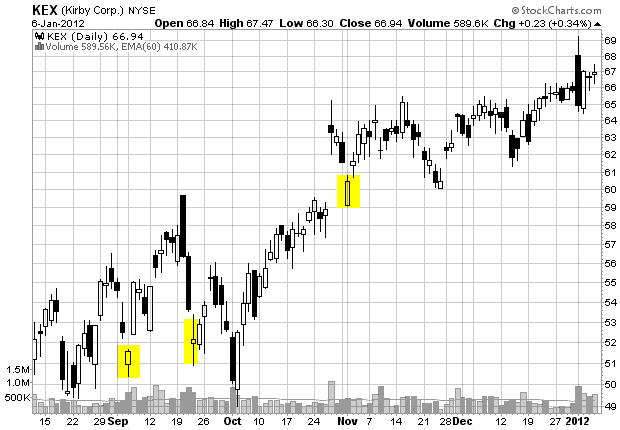
All traders in all financial markets continuously seek for proper tools to analyze the behaviour of the price of the financial assets in order to determine its direction and the right moment to open a position.  Well, there are numbers of solution available through which people can get the right option for their market trading. One of the best solutions is the candlestick chart which is a special type of bar-chart  through which investors can get more information about the price behaviour of any financial  instrument like stocks, currency pairs or derivative for example.

Read more